)
Unlocking the Value of End‑of‑Life HDDs
The information within this copy was supplied by Paladin Envirotech. Visit Paladin Envirotech at Stand 620 or visit their website: https://paladinenvirotech.com/
Introduction and Problem Statement
This paper presents the results of an advanced hard disk drive (HDD) recovery process, enabled by a partnership between WD (San Jose, CA), REcapture (joint venture between Critical Materials Recycling (Boone, IA) and Paladin EnviroTech (Tampa, FL)), and cloud service providers’ data centers. The demonstration reveals end-of-life HDDs that represent a high-value, domestic (United States) source of critical materials with substantially lower environmental impacts compared with primary production (virgin mining and refining). This process efficiency compared with our June 2025 Advanced Recovery and Rare Earth Capture White Paper demonstrates a significant advancement of overall material capture rates from ~80% to >90%.
The process can convert 1,000 kg of HDDs into ~690 kg of aluminum; ~188 kg of recycled ferrous alloys; ~3.2 kg of rare earth oxide (REO); ~10.08 kg of critical and precious metals: ~9.92 kg copper (Cu), 0.06 kg silver (Ag), 0.02 kg gold (Au), and 0.002 kg palladium (Pd); and 15 kg of low-concentration metals. The overall material capture rate is 90.6%. Compared with primary production, the HDD recycling route cuts climate-changing gases by 94.07% overall (8.50 vs. 160.67 kg CO₂e per kg of output). The per-material reductions (kg CO₂e per kg of output) include: aluminum (Al): 0.645 vs 18.6; critical and precious metals: 1.189 vs 108.026; REO: 6.33 vs 32; and ferrous alloys: 0.205 vs 2.04. Substantial reductions were also observed in 11 additional environmental impact categories.
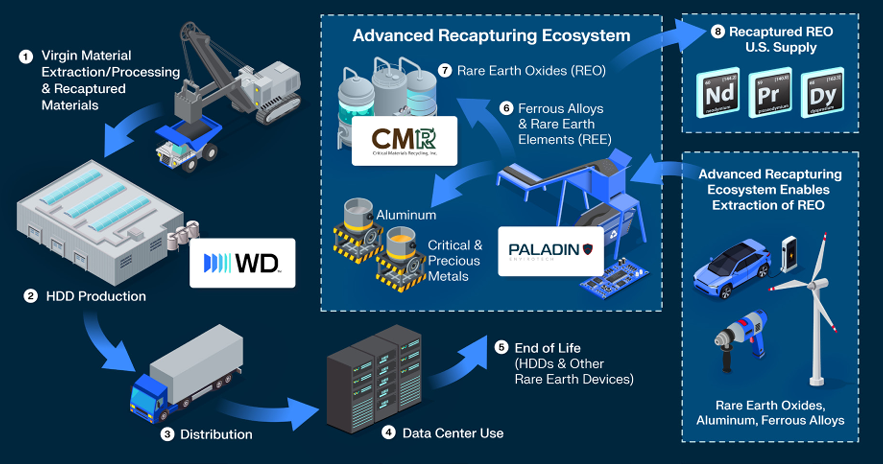
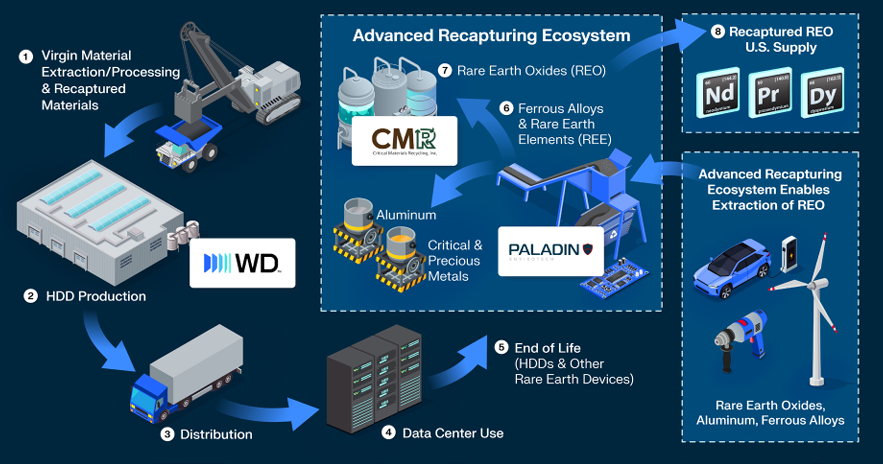
Figure 1: HDDs produced by WD and in use at data centers are then shredded and sorted at Paladin EnviroTech, before undergoing benign chemistry, acid-free dissolution at CMR where rare earth oxides are extracted, then returned to the U.S. supply pool. CMR research notes that the advanced recovery process these partners created has been emulated by other industries to extract rare earths from their hardware, returning even more materials to the U.S. supply
Findings from the U.S. Geological Survey’s 2025 List of Critical Minerals, alongside the growth of the data center storage facilities and the quantified risk of international trade disruptions, form a coherent rationale for scaling domestic HDD recycling. HDDs contain high-value strategic metals such as rare earth elements (REE) and strategic metals like Cu, Au, Ag, and Pd. Recapturing them at scale not only reduces environmental burdens but also functions as a strategic resilience mechanism, lowering U.S. vulnerability to geopolitical shocks, supply shortages, and concentrated foreign production. [1] This recovery approach strengthens national security, supports key clean energy manufacturing sectors with rare earth recovery, and enables the exponential growth of data storage to become an asset for the future U.S. materials economy. The 2024 U.S. Data Center Energy Usage Report highlights a decade of rapid expansion in digital Unlocking the Value of End‑of‑Life HDDs | August 2026 2 White Paper infrastructure and associated storage requirements. [2] HDDs remain the primary medium for bulk data storage, and overall HDD installed base and capacity per drive continue to increase [3]. The enormous scale of HDD deployments ensures a large and steady stream of end-of-life drives entering the waste stream each year, making recovery and recapturing strategically important for material security.
This is fortuitous, because the United States Geological Survey (USGS) published a trade disruption analysis that provides clear evidence for why recovering each of these metals strengthens U.S. economic resilience. [4] REEs (like Nd, Pr, Dy) carry among the highest disruption risks, with China as the dominant supplier. Probability-weighted gross domestic product (GDP) losses under disruption scenarios reach $154M for neodymium, $66M for praseodymium, and $1,624M for dysprosium, placing all three in elevated- to high-risk categories. Advanced recycling can directly offset some of this risk by supplying domestically recovered REE from magnet materials. Copper shows an elevated risk as well: $56M probability-weighted GDP impact, largely tied to refined copper imports from Chile. Aluminum faces an even greater $201M expected GDP impact linked to dependence on Canadian supply. Silver, another recaptured metal, carries elevated risk with a $36M GDP impact, mainly due to reliance on Mexico supply. [4]
To find out more, access Paladin Envirotech's full White Paper with the button below:
About the Events
Critical Minerals Expo North America brings together organisations involved in the mining, processing, refining, recovery and recycling of the strategic materials that underpin advanced manufacturing, clean energy, defence and emerging technologies.
Battery Recycling Expo North America explores the technologies, policies and commercial developments shaping lithium-ion battery recycling, critical material recovery and circular battery supply chains.
E-Waste World Expo North America brings together organisations involved in electronics recycling, IT asset disposition (ITAD), refurbishment, material recovery and circular electronics manufacturing.
)