
Measuring what matters: closing the information gap in recycling mixed metals and e-waste
The information within this copy was supplied by Scantech International. For more information, you can visit them on their Booth 428 or visit their website: https://scantech-international.com/
Recyclers increasingly handle high value, highly variable material, from mixed metals and e-waste to battery black mass. Yet much of it is still purchased, sorted, processed, refined and on-sold on the strength of a grab sample or surface-based measurement. This gap is where value leakage can occur.
Why a Handful of Samples Cannot Representatively Characterise Incoming Scrap Streams:
A shredded, mixed or baled scrap stream is heterogeneous by nature. Precious metals, light elements and contaminants sit unevenly through it, so a grab sample or surface measurement rarely represents the entire flow or batch of material. Decisions on purity, blending and payment are then based on samples that describe a few kilograms and are often delayed due to lengthy laboratory assay lead times.
The commercial consequences are familiar to anyone in the yard. You pay for a grade you did not receive, or you ship a grade you were not paid for. Process contaminants such as chlorine and mercury can pass undetected into a furnace or refinery, damaging product quality and equipment. Equally, small or hidden concentrations of valuable elements, such as gold, silver and copper in a mixed stream, go unrecovered because a small sample never sees them. It is the limit of what a small sub-sample or surface analysis can tell you about a heterogenous mixed scrap stream.
Measuring the Whole Stream, Not a Piece of it:
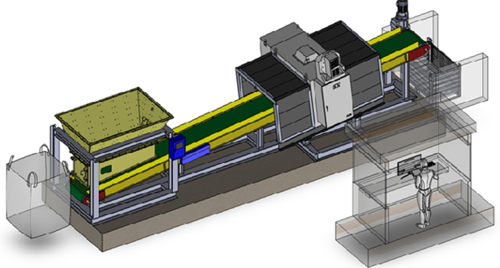
Prompt gamma neutron activation analysis, or PGNAA, takes a different approach. Rather than sampling, it measures the entire material as it passes. Neutrons penetrate the full depth of the bed, elements present emit a gamma signature unique to each element and a detection system reads the bulk flow continuously. The measurement is representative because it sees everything and is unaffected by particle size, belt speed or segregation. It reports many elements at once, from precious metals, ferrous / non-ferrous, to light elements such as carbon and aluminium. Scantech applies this in two ways for recyclers. GEOSCAN-R analyses conveyed scrap on the belt. For big bags and pallets where no conveyor exists, the same analysis is available as a static batch measurement. Both draw on technology proven across more than 400 installations in mining and cement over three decades, now configured for the recycling stream.
From Measurement to Settlement:
Representative, real time composition data changes what a recycler can do. You can confirm the quality you paid for and quantify purity and contaminants on the material in front of you. You can build stockpiles by grade, control the blend feeding a downstream process, and hold product to specification before it leaves. In a smelter, the same data lets operators match flux additions to the actual charge chemistry rather than an assumed average, which matters where copper and other non-ferrous feeds can vary batch to batch.
It can also form an agreed basis for earlier payment, because the measurement is timely and representative, thereby closing the gap between when material is processed and when it is settled. None of this replaces the laboratory.
Analysers must be calibrated to your material, sampling still verifies the calibration while trace elements and formal certification will still need laboratory work. Moving from a sample to the full stream is the difference between estimating value and knowing it with confidence. Recyclers who measure their stream recover more of what they process and dispute it less. In a market where the material is only getting more valuable and more complex, that advantage is hard to ignore.
About the Events
Critical Minerals Expo North America brings together organisations involved in the mining, processing, refining, recovery and recycling of the strategic materials that underpin advanced manufacturing, clean energy, defence and emerging technologies.
Battery Recycling Expo North America explores the technologies, policies and commercial developments shaping lithium-ion battery recycling, critical material recovery and circular battery supply chains.
E-Waste World Expo North America brings together organisations involved in electronics recycling, IT asset disposition (ITAD), refurbishment, material recovery and circular electronics manufacturing.