)
E-Scrap Phase Characterisation: Research into Waste Printed Circuit Boards
The information within this copy was supplied by AHK Group. Visit AHK Group at Stand 320 or visit their website: https://www.ahkgroup.com/
By 2030, global electronic scrap (e-scrap) generation is projected to exceed 80 million tonnes. As volumes increase, advanced techniques like e-scrap phase characterisation are becoming critical to understanding material composition and behaviour, supporting more efficient recovery of the raw materials essential to modern manufacturing.
Anticipated constraints in the supply of primary metals are expected to increase reliance on the recycling of end-of-life electronic equipment. Consequently, extracting valuable secondary metals from this growing volume of e-scrap presents a strategically important opportunity to secure future supply chains and support the development of the circular economy.
Experimental research conducted by Alfred H Knight and our research partners investigates the phase characteristics of waste printed circuit boards (WPCBs) to better understand the recycling and metal recovery opportunities within these complex materials.
WHAT MAKES E-SCRAP SO COMPLEX?
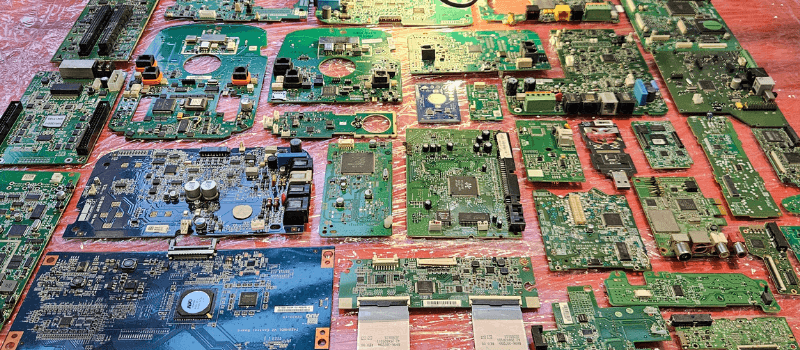
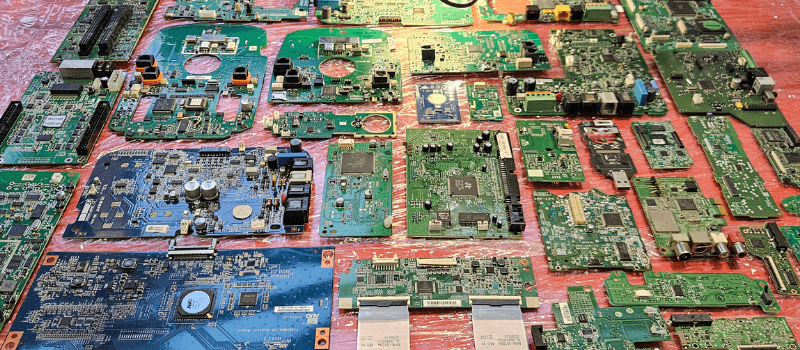
While e-scrap, or Waste Electrical and Electronic Equipment (WEEE), broadly encompasses all end-of-life electrical equipment, the recycling industry is increasingly challenged by the hyper-complex, heterogeneous nature of WPCBs.
These boards are not just a simple source of recoverable gold, copper, platinum, palladium, and silver. Instead, they form a densely packed composite matrix in which valuable payable metals are tightly associated with penalty elements, including bromine, chlorine, chromium, lead, and antimony. Because of this, accurately assessing the material poses a significant challenge.
Traditional bulk chemical analysis requires the complete dissolution of the sample to achieve an overall elemental value. In doing so, it removes the physical information needed to understand particle size, morphology, and the textural association of different elements within the material. We also lose information on what compounds these elements are found within.
WHAT IS E-SCRAP PHASE CHARACTERISATION?
E-scrap phase characterisation examines how different compounds and elements are physically and chemically associated within a sample.
Rather than simply identifying which elements are present, phase characterisation determines how those elements occur within the material structure. This includes identifying the mineral or material phases present, the particle size of those phases, and how valuable metals are distributed throughout the sample.
For complex secondary materials such as waste printed circuit boards, this information can help recyclers understand metal liberation potential, identify penalty components and their distributions/associations, and evaluate the most suitable downstream processing routes.
A GEOMETALLURGICAL APPROACH TO E-SCRAP PHASE CHARACTERISATION
To overcome the limitations of standard bulk chemical assays, Alfred H Knight applies a geometallurgical approach. Traditionally used in the primary mining sector to evaluate complex geological ores, this methodology is now proving highly effective for secondary waste streams. By treating e-scrap as a synthetic ore, analysts can examine the specific physical and chemical characteristics of the material at a microscopic level.
To better understand material heterogeneity during processing, AHK conducted experimental research using a 100 kg sample of medium-high gold (Au) grade e-scrap. To mirror industrial recycling steps, the material was carefully sub-sampled and separated into different preparation stages. This included fractions shredded to < 30 mm, < 8 mm, and < 1 mm, and further treatment by incineration, pyrite matte, aluminium matte, and melting with excess copper.
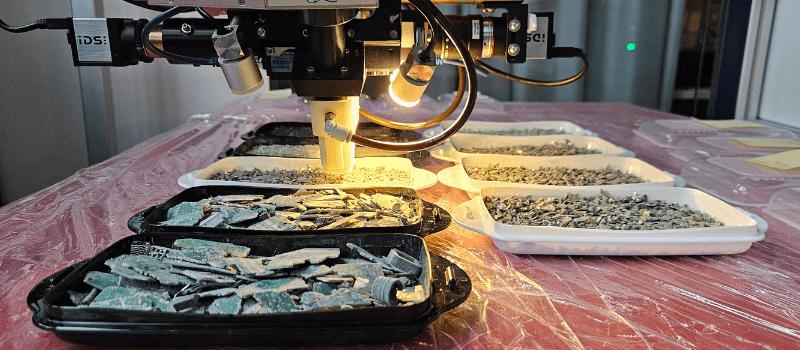
Alongside dissolving the samples for bulk chemical analysis, the technical team utilised advanced, non-destructive analytical instruments to extract a wealth of physical data. The research employed Micro-XRF (Micro X-Ray Fluorescence) to provide rapid elemental mapping of the unprepared samples. Following this, Automated SEM-EDS (Scanning Electron Microscopy with Energy Dispersive Spectroscopy), using the AMICS software package, was deployed for highly detailed particle analysis.
THE RESULTS: WHAT THE RESEARCH REVEALS
The application of Micro-XRF and Automated SEM-EDS provided a comprehensive visual and chemical understanding of the WPCB samples across all preparation stages. Rather than simply returning a list of chemical elements, the advanced imaging provided detailed insight into particle size, morphology, and the textural association of the different materials present.
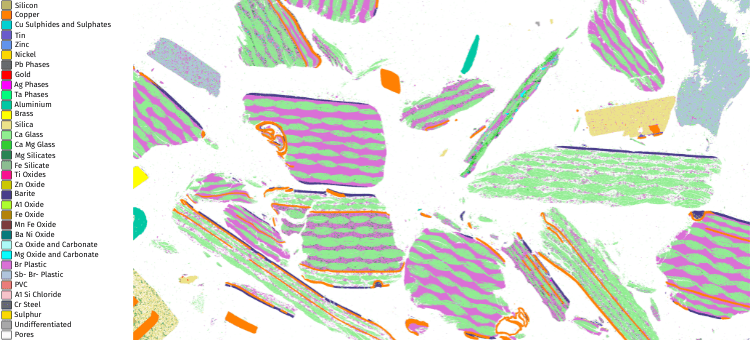
Specifically, the research successfully mapped the precise locations of highly valuable payable metals, including gold, copper, platinum and silver. The analysis demonstrated how precious metals are distributed after various stages of sample preparation and whether they are liberated or locked within composite phases.
Importantly, the non-destructive imaging also identified the presence and spatial distribution of penalty elements and environmental contaminants. For example, the analytical techniques clearly pinpointed the location of bromine-bearing plastics and multi-element glass phases. By mapping these impurities alongside the payable metals, the research provided a complete, actionable picture of the material’s physical makeup.
WHY IS THIS IMPORTANT FOR THE RECYCLING INDUSTRY?
The data gathered through AHK’s geometallurgical approach provides recyclers with a much clearer understanding of the characteristics of their feed material. For an industry handling increasingly complex waste streams, this level of detail offers a significant commercial advantage.
Optimising Physical Separation
By accurately predicting the liberation potential of WPCBs, operators can refine their size reduction processes. Instead of applying a uniform approach, facilities can adjust shredding, grinding, and sorting parameters to separate valuable metals from the composite material matrix much more efficiently.
Improving Downstream Processing
Furthermore, mapping the specific distribution of payables and impurities/penalties allows for better strategic decision-making downstream. Recyclers can maximise the recovery of high-value elements like gold, copper, platinum, palladium, silver, and other elements of economic interest, while identifying potentially problematic materials, such as halogenated plastics or penalty elements, that may influence downstream processing in pyrometallurgical or hydrometallurgical circuits.
Ultimately, this research empowers the industry to process e-scrap more sustainably and extract crucial metals more efficiently.
REQUEST A COPY OF OUR E-SCRAP PHASE CHARACTERISATION RESEARCH
AHK expert Omar Amri, Technical Representative, delivered the findings from this experimental research into waste printed circuit boards (WPCBs) at the International Electronics Recycling Congress (IERC).
Alfred H Knight supports organisations working with complex e-scrap streams through independent sampling, inspection, and advanced analytical services. Our teams combine geometallurgical analysis, automated mineralogy, and material characterisation techniques to help recyclers, processors, and traders better understand the composition of their materials and optimise recovery processes.

About the Events
Critical Minerals Expo North America brings together organisations involved in the mining, processing, refining, recovery and recycling of the strategic materials that underpin advanced manufacturing, clean energy, defence and emerging technologies.
Battery Recycling Expo North America explores the technologies, policies and commercial developments shaping lithium-ion battery recycling, critical material recovery and circular battery supply chains.
E-Waste World Expo North America brings together organisations involved in electronics recycling, IT asset disposition (ITAD), refurbishment, material recovery and circular electronics manufacturing.
)